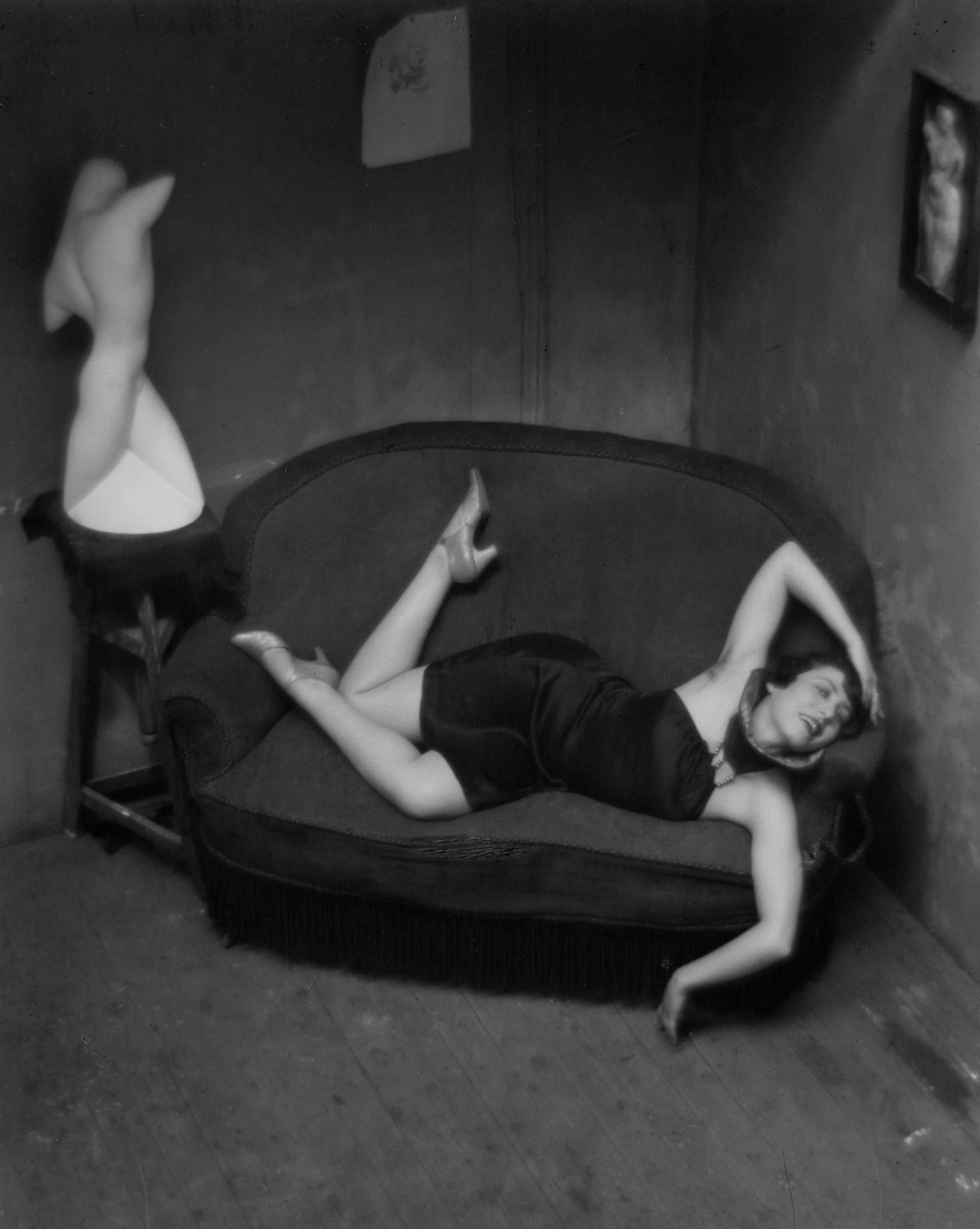
“Look at Magda Förstner: her eyes vibrate, her mouth tenses, her nostrils quiver, her body knots, folds, opens up…,” marveled a critic for the Parisian daily Le Soir in 1927. He was reviewing the Hungarian dancer’s performance at the Sorbonne. To him, she represented “the whole fantasy, the whole new rhythm, the whole music hall of today with its astonishing verve.”
Around that same time, Magda met an eager young Hungarian photographer in Paris named André Kertész. They arranged for a shoot at the studio of a mutual friend, the sculptor István Beöthy. According to one account of how Satiric Dancer came about at that shoot, André asked Magda to do something amusing in the spirit of Beöthy’s work Héros, Action Direct (Torso), and she swung into this pose.
Although no one recognized it at the time, Satiric Dancer epitomizes les années folles (the Jazz Age) in Paris. It’s the time and place to which Woody Allen’s character Gil Pender aspires in Midnight in Paris. The time and place of Josephine Baker and La Revue Nègre. Of the Surrealists. Gertrude Stein. Coco Chanel. Marc Chagall. Sidney Bechet. Kiki of Montparnasse. Of the American expat, the Central European artist, the New Woman. All had converged on Paris after the Great War, avid for modern living, radical art, and cosmopolitan pleasures.
Favorite hotspots included the music halls where hoofers like Förstner and Josephine Baker performed and the cabarets where folks danced the Charleston, the black bottom, the foxtrot, the tango. Surely the atrocities of war contributed to this intoxication by dance.
Estimates of the number of disabled French veterans range between seventy thousand and seven million. In any case, men with prostheses, crutches, and pinned-up sleeves were everywhere, as many of André’s photographs attest. In the metro, certain seats were reserved for “mutilés de guerre” (the war wounded). In that context, how thrilling to romp on a dance floor.
Despite Förstner’s “astonishing verve,” the mournful aspect of French life in the 1920s haunts Satiric Dancertoo. The hero Beöthy depicts in his sculpture is quadriplegic. The woman in his bas relief on the opposite wall lacks arms. (Beöthy himself had suffered a war wound. So had André, who lost the use of his left arm for over a year.) As for Magda, her left arm hangs limp in André’s image. Indeed, she poses like an unused articulated marionette.
This brokenness foreshadows her future. Although much of Magda’s later life remains obscure, we know that she danced professionally throughout Europe until 1934. She then started a business selling the whimsical dolls and animals she designed and paid rural women to fabricate. Reportedly, her creations sold briskly in England and the US.
Five years later, World War II erupted. Over half a million Hungarian Jews would perish in the Holocaust. The Förstners were Jewish, yet Magda survived. Her brother, the painter and caricaturist Dénes Faddi-Förstner, did not. He died in a gas chamber at Mauthausen on the eve of the camp’s liberation.
The following decade brought the 1956 Hungarian Revolution. After the Soviets crushed the uprising, some 200,000 refugees poured out of Hungary. Magda, her biochemist husband, and their child fled to Toronto, Canada. There she struggled to continue her business. Later she turned to, then abandoned, weaving. Her health deteriorated. Yet music—New Orleans jazz, Gershwin, Harry Belafonte, Elvis, the Rolling Stones—still sent her heart soaring.
Wracked by pain, Magda Förstner died by her own hand in 1977.